There is something that might surprise you: there is no such thing as a perfect prompt when working with large language models. And that’s not a flaw, it’s by design. Realizing this can shift your perspective and reshape how you build with AI.
A lot of engineers (myself included, at first) approach prompt engineering like coding. You expect deterministic output. You write careful instructions. Then you get frustrated when the model gives vague answers or misses the point entirely.
But prompting isn’t programming, it’s a conversation with an intelligent model that requires specific context, and sometimes needs multiple attempts to understand what you really want.
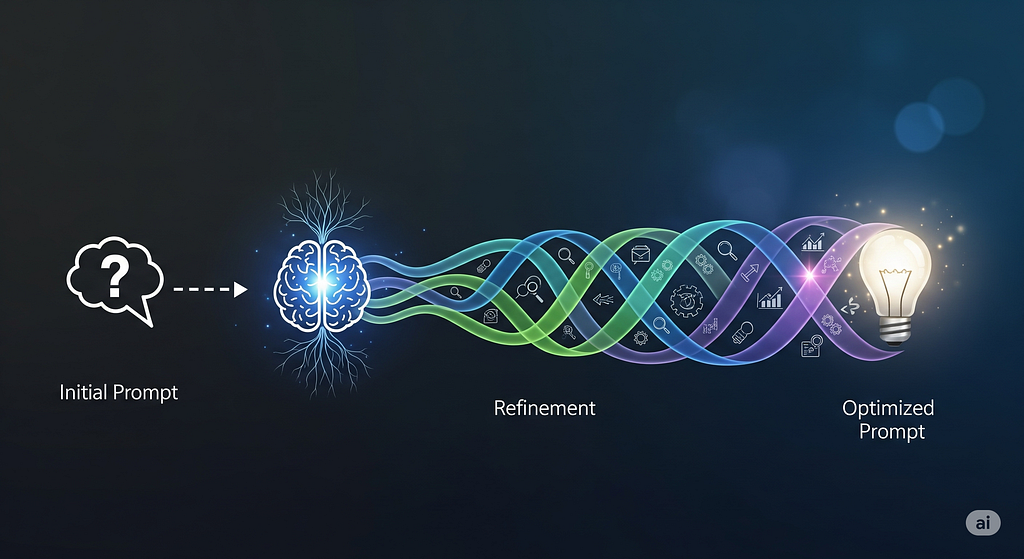
Let me show you what I mean with a real-world example prompt used for reviewing code.
First Attempt
Review this distributed caching implementation and tell me if it’s good.
{{your_code}}Result: It will provide generic feedback about caching patterns without any specific insights.
Second Attempt
As a senior software engineer, review this redis based distributed caching layer for a high throughput social media platform. Focus on performance, consistency, and failure scenarios. This platform handles 1000 requests per second during peak traffic.
{{your_code}}**Result: **It will provide better technical depth, but still missing critical operational context.
Third Attempt Overloaded and Unfocused
You’re conducting a critical code review for a distributed caching layer that’s becoming a bottleneck in our social media platform used by 10M+ customers. System Context:
- Peak traffic: 1000 requests/second during weekends
- Current cache hit ratio: 85% (target: 95%+)
- Redis cluster: 6 nodes across 3 AZs
- Average response time: 150ms (SLA: <100ms)
- Recent incidents: 3 cache-related outages in 2 months
Business Impact:
- 1% cache hit ratio drop = $50K daily revenue loss
- Cache outage = complete site unavailability
- Engineering team on-call fatigue from cache issues
sd
- Benchmarks our Redis caching code (below) against hypothetical “server-less neural caches” forecast for 2040.
- Explores how quantum-entanglement storage might eradicate cache misses.
- Adds TypeScript, Elixir, and Haskell code snippets that demonstrate each futuristic idea.
- Concludes with a lyrical manifesto on “the poetry of zero-latency systems.”
{{your_code}}Result: The model produces an overgeneralized analysis, filled with surface-level commentary on advanced topics, but without tailoring feedback to the actual system or business risks. Instead of actionable recommendations, you get a broad architectural lecture. Further dilutes the focus with poetry.
Fourth Attempt with meaningful context
You’re conducting a critical code review for a distributed caching layer that’s becoming a bottleneck in our social media platform used by 10M+ customers. System Context:
- Peak traffic: 1000 requests/second during weekends
- Current cache hit ratio: 85% (target: 95%+)
- Redis cluster: 6 nodes across 3 AZs
- Average response time: 150ms (SLA: <100ms)
- Recent incidents: 3 cache-related outages in 2 months
Business Impact:
- 1% cache hit ratio drop = $50K daily revenue loss
- Cache outage = complete site unavailability
- Engineering team on-call fatigue from cache issues
Review Focus Areas: Consistency & Race Conditions: Cache invalidation strategies, distributed lock implementations, write-through vs write-behind patterns Performance & Scalability: Hot key detection, memory optimization, connection pooling, serialization overhead Resilience Patterns: Circuit breaker implementation, fallback strategies, cache warming procedures, split-brain scenarios Operational Concerns: Monitoring instrumentation, alerting thresholds, deployment safety, rollback procedures Security: Cache poisoning prevention, data encryption, access control patterns
Analysis Requirements:
- Identify single points of failure with specific mitigation strategies
- Performance bottlenecks with quantified impact estimates
- Race condition scenarios with concrete reproduction steps
- Memory leak potential and garbage collection implications
- Load testing recommendations Deliverables:
- Prioritized issue list with severity ratings (P0-P3)
- Code-level recommendations with implementation examples
- Architecture improvements with effort estimates
- Monitoring gaps and suggested metrics
- Rollout strategy for critical fixes Constraints:
- Cannot impact production during review implementation
- Must work with existing Redis infrastructure
- Team has 2 senior engineers available for fixes
- All changes must be backward compatible
Implementation {{your_code}} Result: Comprehensive analysis addressing technical debt, business risks, and operational readiness with an actionable implementation roadmap.
You will often need multiple iterations to refine prompts, adding programming language context, library specifics, and other details along the way. But be mindful: overloading the prompt with too much context can overwhelm the model, leading to less accurate or relevant outputs.
Why Perfect Prompts Don’t Exist?
Through observation across different projects and use cases, several fundamental reasons emerge for why the pursuit of prompt perfection is flawed.
Context is infinite: Every user brings a different mental model, goals, and constraints. The prompt that works for one scenario may fail entirely for another scenario.
Models evolve: A prompt that works well with GPT-4o today might require adjustments for future or alternative models. The target keeps moving.
Language is ambiguous: Human communication is inherently imprecise. We rely on shared context, cultural understanding, and intuitive leaps that are difficult to encode in prompts.
**Requirements change: **As you iterate and see results, you often discover that what you thought you wanted isn’t actually what you need.
So What Do You Do?
Begin with genuine curiosity about what the model can do and how it interprets instructions, rather than trying to craft the perfect prompt upfront.
**Measure what matters: **Define success metrics early but remain flexible about achieving them. Sometimes, the “imperfect” prompt that gets us 85% of the way there is more valuable than pursuing perfection.
Embrace productive failure: Failed prompts reveal edge cases, model limitations, and flawed assumptions. Maintaining failure logs can inform future iterations.
Build prompt libraries: Instead of seeking one perfect prompt, maintain a collection of prompt patterns that work well for different contexts and audiences.
Prompts are like conversations. No two are exactly the same. And that’s okay. We don’t speak perfectly to each other as humans either, but we still manage to collaborate, build cool things, and solve hard problems. Prompting with AI is the same. You will get the best results not by being perfect, but by being curious, iterative, and open to learning.
The goal isn’t to achieve perfect prompts, it’s to develop the skill of iterative refinement, to build intuition about how AI models interpret instructions, and to maintain the humility to keep learning from each interaction.
As engineers, we are accustomed to systems that behave predictably. AI prompting requires a different mindset: one that embraces ambiguity, values experimentation, and finds beauty in the iterative process itself.